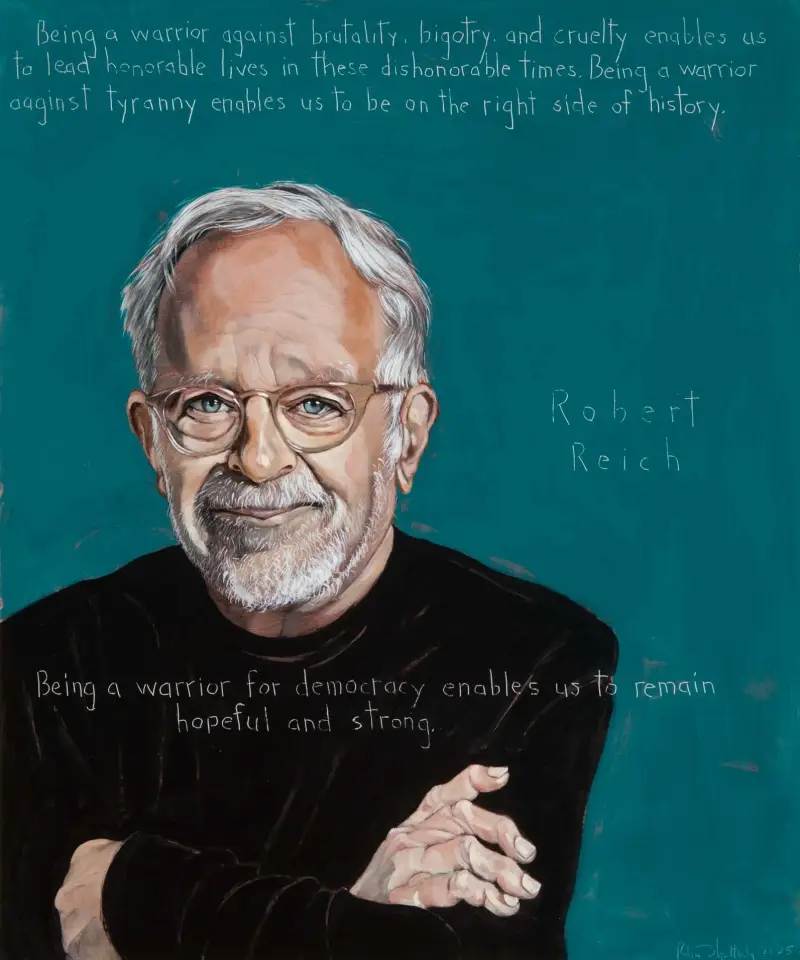
Robert Reich
Political Leader, Public Servant, Educator, Commentator: b. 1946
“Being a warrior against brutality, bigotry, and cruelty enables us to lead honorable lives in these dishonorable times.
Being a warrior against tyranny enables us to be on the right side of history.
Being a warrior for democracy enables us to remain hopeful and strong.”
Why I painted Robert Reich
Artist Robert Shetterly explains his respect for Reich's persistent, decades-long message of how vast disparities of wealth and poverty undermine democracy and what we can do to change the trajectory.
Speaking Truth to Youth
Political leader, public servant, and educator Robert Reich encourages young people to follow their hearts and use their resources to make the world a little bit better.
Biography
Robert B. Reich is a best-selling author, educator, political commentator, and public servant. He has served in three presidential administrations, including as Secretary of Labor under President Bill Clinton, and is the author of nineteen books, including the recently-released Coming Up Short: A Memoir of My America (2025). In 2023, he retired as a Professor of Public Policy at the University of California, Berkeley, capping off a four-decade teaching career. He continues to work as a commentator and author, providing a critical voice of reason and guidance, urging all Americans to do their part to help save democracy from corruption and authoritarianism.
Born at the dawn of the Baby Boom, Reich was often picked on as a child for his short stature—the result of a rare genetic disorder—and befriended older classmates to defend him from bullies. One of his close protectors was future civil rights activist Michael Schwerner, who Reich remembers for his “calm good nature [that] seemed to automatically cast a positive spell over kids who’d otherwise turn to bullying.”
Years later, when he learned Schwerner had been murdered by the Ku Klux Klan during Freedom Summer, Reich says that something “snapped” inside of him and made him “see everything differently.”
“Before, I understood bullying as a few kids picking on me for being short. After I learned what happened to Mickey, I began to see bullying on a larger scale, all around me . . . I had a different understanding of the meaning of justice. It became as personal to me as were the bullies who called me names and threatened me in school and on the playground—but larger, more encompassing, and more urgent.” In Coming Up Short, Reich ponders how the quintessential “bully’s bully” could be serving a second term as President of the United States. Reich asked himself, “How did this happen?” and found the answer in our nation’s ever-growing wealth gap, a condition caused by the growing influence of money in our political system and government’s gradual abandonment of the working class.
Reich has dedicated his life to pursuing this moral calling through public service. He interned for Senator Robert F. Kennedy in 1967, won a Rhodes Scholarship in 1968, and graduated from Yale Law School in 1970. In the late 1970s, Reich fought on the frontlines against the corporate takeover of politics as head of policy for the Federal Trade Commission. In the 1980s, he became a leading national expert on labor relations and industrial policy and advised Democratic presidential candidates on economic policy.
In 1993, Reich was named Secretary of Labor by President Bill Clinton, his former Oxford and Yale classmate. Reich’s signature achievements in the Clinton administration included implementing the Family and Medical Leave Act, leading a national fight against sweatshops and illegal child labor, expanding worker training opportunities, and successfully lobbying a Republican Congress to raise the federal minimum wage. As Labor Secretary, Reich also used his perch to speak truth to power, calling out lucrative subsidies for large corporations (“corporate welfare”) and out-of-control CEO pay. For his leadership, Time magazine named Reich one of the ten most successful cabinet secretaries of the twentieth century.
Despite his friendship with the president, Reich often struggled to gain Clinton’s ear over more corporatist advisors. His prescient warnings about economic inequality went largely unheeded by the Clinton administration, including a 1994 speech in which Reich warned America was “on the way to becoming a two-tiered society composed of a few winners and a larger group of Americans left behind, whose anger and disillusionment are easily manipulated.”
Reich left the Cabinet at the end of Clinton’s first term, wishing to spend more time with his then-teenage sons Adam (today, a professor at Columbia) and Sam (now host of the Dropout series Game Changer).
“I have the best job I’ve ever had and probably ever will,” he wrote at the time. “I also have the best family I’ll ever have, and I can’t get enough of them. Finding a better balance? I’ve been kidding myself into thinking there is one. I had to choose.”
After leaving the Cabinet, Reich returned to his first love: teaching. From 2006 to 2023, he taught the popular Wealth and Poverty course at UC-Berkeley, offering undergraduates a deeper understanding of the causes and consequences of widening economic inequality in America.
During this period, and in his 2025 memoir, Reich has distilled his decades of research and analysis into a consistent, laser-focused message.
“Capitalism and democracy, we’ve long been told, are the twin ideological pillars capable of bringing unprecedented prosperity and freedom to the world.” He explains that to function in a way that simultaneously builds wealth and protects the individual freedoms inherent to true democracy, the two systems must remain in balance, with each system taking its appropriate role.
“Capitalism’s role is to increase the economic pie, nothing more.” It is then up to the government and people to steer management of the pie toward the common good. In the last fifty years, an imbalance has developed as “capitalism has become more responsive to what we want as individual purchasers of goods . . . and democracy has grown less responsive to what we want together as citizens.” The threats to this balance—uneven distribution of wealth, corruption, and a citizenry that takes democracy for granted—have intensified considerably in the era of Donald Trump.
“The common good recognizes that we’re all in this together. Instead of being self-seeking individuals who happen to live within the same political and geographic boundaries, we are a group of people with responsibilities to one another. . . . [O]ur civic life . . . seems to have sharply deteriorated. We are bitterly divided. Racism, xenophobia, misogyny, and homophobia are more apparent. A selfishness has infused many of our dealings with one another. . . . What we have lost is a sense of our connectedness to each other as Americans.”
“Wealth inequality is eating this country alive.”
Reich is a hopeful person and believes the United States will come through this difficult stage with democracy intact. On September 25, 2025, several months into the Trump presidency, Reich wrote in his Sunday Thought column, “The slumbering giant of America is awakening.” He watches people—Democrats and Republicans—beginning to recognize that everyone is at risk when the rule of law is ignored, and he believes that a breaking point will be reached and the freefall toward fascism stopped. “Democracy is not a spectator sport,” he reminds us, and all of us must participate to keep it strong.
“Citizens concerned about democracy must monitor those in power, act as watchdogs against abuses of power, challenge those abuses, organize and litigate, and sound the alarm about wrongdoing and wrongful policies.” Reich urges us to write letters to the editor, call our representatives, hold up a sign at a demonstration, and follow the advice of John Lewis, causing “good trouble.”
Through his dogged reminders that our country is best served when democracy and capitalism walk hand in hand, in proper balance, Robert Reich is providing the leadership we need, inspiring us to save our democracy. His writings and teachings serve as the perfect tonic to “awaken the giant” and to restore power back into the hands of the people.
– authored by Julie Gronlund and Vishal Shankar (2025)
Related Portraits



Programs
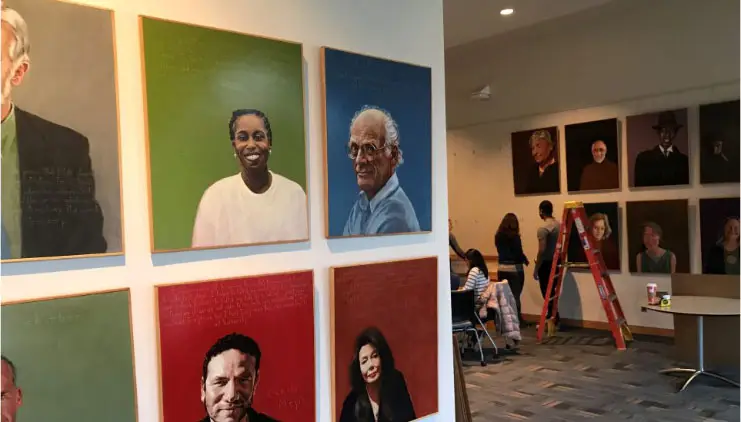
Americans Who Tell the Truth (AWTT) offers a variety of ways to engage with its portraits and portrait subjects. Host an exhibit, use our free lesson plans and educational programs, or engage with a member of the AWTT team or portrait subjects.

Education
AWTT has educational materials and lesson plans that ask students to grapple with truth, justice, and freedom.
Exhibits & Community Engagement
AWTT encourages community engagement programs and exhibits accompanied by public events that stimulate dialogue around citizenship, education, and activism.