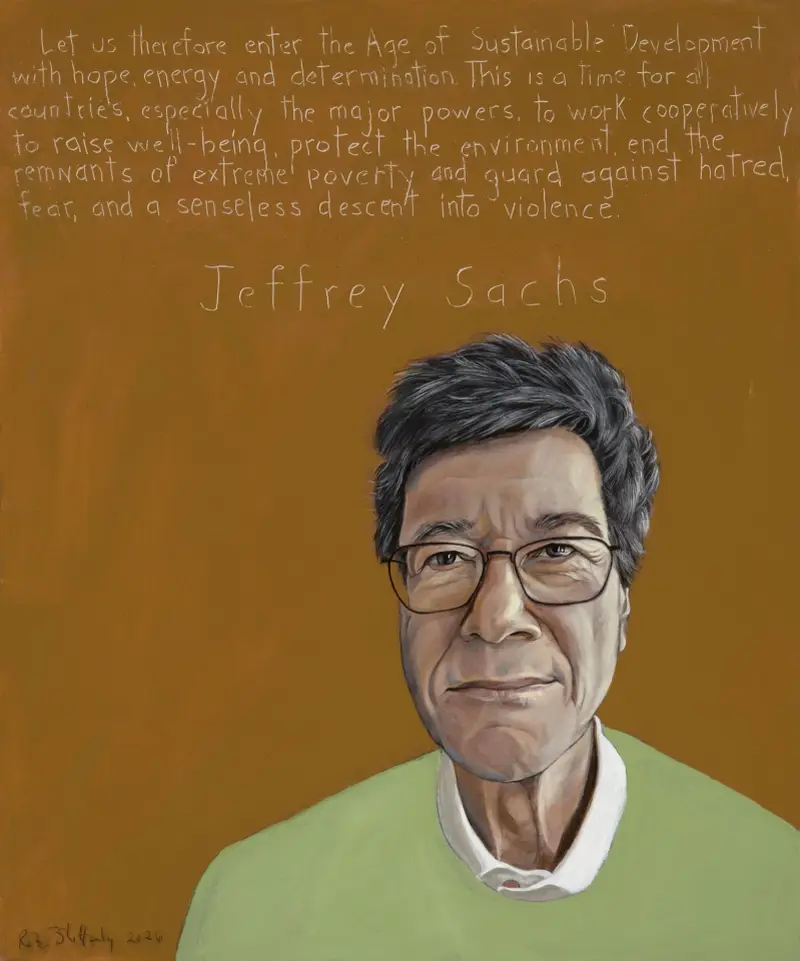
That Jeffrey Sachs is brilliant there can be no argument. That he is also controversial may, perhaps, be equally inarguable. That he is an unabashed truth teller, confident his opinions are fact-based, and that he is an indefatigable champion of the causes he undertakes may explain the controversy. That those opinions often may be contrary to American foreign policy orthodoxy sharpens the picture.
Sachs, born in 1954, is an academic of the highest order, having earned his B.A., M.A., and Ph.D.at Harvard University prior to being a tenured professor there for over twenty years.
His credentials are mind-boggling. He serves as the Director of the Center for Sustainable Development at Columbia University and holds that institute’s highest academic rank of University Professor. Other positions include:
- Founder and President, UN Sustainable Development Solutions Network (SDSN)
- Sustainable Development Goals (SDGs) advocate under Secretary Antonio Gutierres
- Academician of the Pontifical Academy of Social Sciences, Vatican
- Co-founder and director, Millenium Promise Alliance
- Honorary Tan Sri Dr. Jeffrey Cheah Distinguished Professor of Sustainable Development, Sunway University
- Co-chair of the Council of Engineers for the Energy Transition
- Economic advisor to governments in Latin America, Europe, Africa, and Asia
Each of these positions clearly demand time and extra-ordinary engagement. One would wonder, “Does the man ever sleep?”
An unabridged bio of Professor Sachs would include fourteen books including three New York Times best-sellers (The End of Poverty (2005), Common Wealth: Economics for a Crowded Planet (2008), and The Price of Civilization (2011)), 215 refereed academic journal articles, 1,076 (not a typo) published newspaper and magazine articles and columns, over thirty-five congressional testimonies, forty-five honorary degrees (twenty-five of which were bestowed by other than U.S. institutions), advisory positions/activities in over twenty-five countries, fifty-three selected awards and scholarships—to include most notably listed here:
- Tang Prize in Sustainable Development (2022)
- Co-recipient of the Blue Planet (Global) Prize for Environmental Leadership (2015)
- Twice named among Time magazine’s 100 most influential leaders
- Legion of Honor Decree from the President of the Republic of France
- Order of the Cross from the President of Estonia
It would follow that one so inordinately capable and driven as Professor Sachs, might have ruffled some feathers, and would be, as alluded to above, controversial. This admirer suspects the “rub” may arise from and, in large part, be attributable to Sachs’s problem with the widely held belief in American exceptionalism. Sachs does not believe in any country’s self-proclaimed exceptionalism, he believes in cooperation. In his A New Foreign Policy, Beyond American Exceptionalism (2018), he writes, “In recent decades American-led military interventions in Vietnam, Cambodia, Laos, Guatemala, Haiti, Nicaragua, El Salvador, Afghanistan, Iran, Iraq, Libya, Yemen and Syria, just to name a few, have led to repeated bloodbaths and disasters, not American victory and security.”
Sachs generally approaches global issues from a planet-centered worldview, not a narrowly nationalistic frame. Unsurprisingly, his perspectives fly in the face of establishment opinions grounded in American exceptionalism. He sees our vast empire of over eight hundred military bases on foreign lands as the essence of inanity, heightening tensions rather than promoting peace and stability—very much symbolic of a renegade nation. In New Foreign Policy he calls for the United States, among other things, to:
- Live by the UN Charter
- Recommit to Sustainable Development Goals and the Paris Climate Agreement
- Ratify pending UN treaties (The United States is now a non-signatory to several, including treaties on women, the disabled, children, bio-diversity, the International Criminal Court.)
- End C.I.A. covert operations
When we look at present day America, these words by Sachs seem particularly prescient:
“The challenges before us cannot be met by a leader more interested in personal gain than in national renewal.
“When citizens disengage, power concentrates in fewer hands and accountability disappears. That is why civic responsibility has never been more important. If you do not shape the future, others will.”