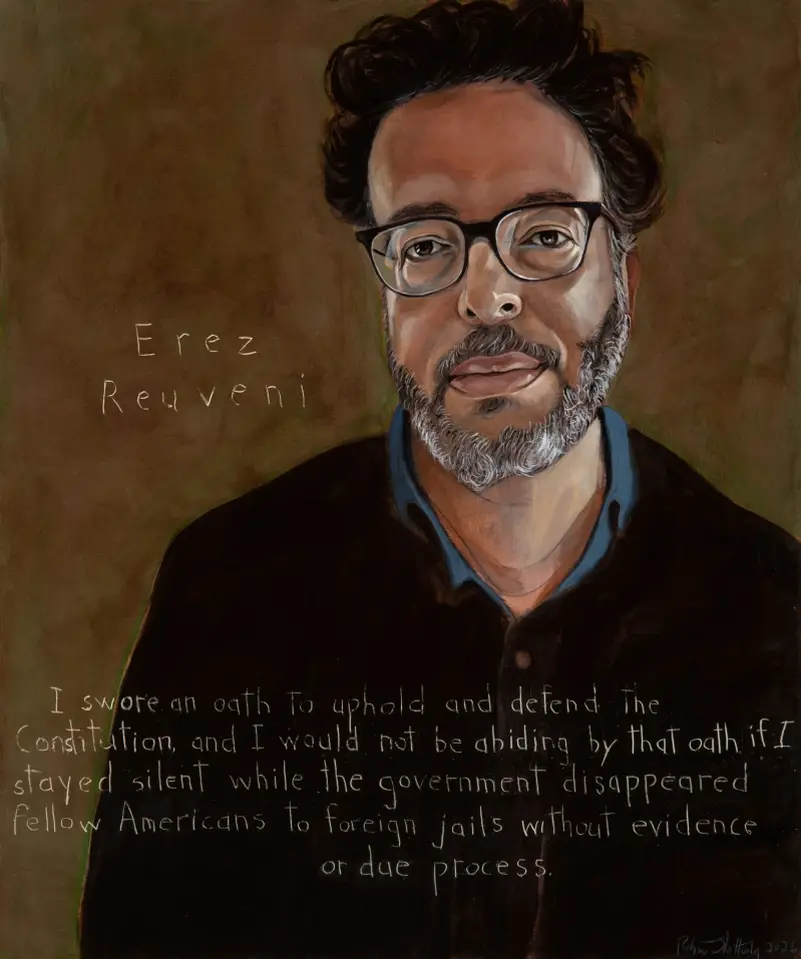
Erez Reuveni
Public servant, U.S. attorney, Whistleblower: b. 1982
“I swore an oath to uphold and defend the Constitution, and I would not be abiding by that oath if I stayed silent while the government disappeared fellow Americans to foreign jails without evidence or due process.”
Speaking Truth to Youth: Erez Reuveni
Public servant, U.S. attorney, and whistleblower Erez Reuveni believes that optimism is contagious and encourages young people to find something they believe in, find others who share that belief, and build a community of support.
Biography
It takes a certain kind of lawyer to work for the Department of Justice. They should be proficient in constitutional law and have a deep understanding of the legal frameworks that shape U.S. policy. They must zealously advocate on behalf of their clients regardless of political party or their agreement with the policies the government is implementing, so long as those policies are legally permissible. As advocates for the United States, attorneys working for the federal government have a higher calling than do other attorneys. They cannot simply work to win a case at all costs. In serving the American people, they must ensure that justice is done. Erez Reuveni is one such lawyer.
Erez Reuveni’s dream to pursue justice on behalf of the American people came true in 2010 when he was offered a position in the U.S. Department of Justice. Reuveni imagined he would stay there his entire career. His unwavering commitment to uphold the U.S. Constitution enabled him to set aside political ideology and apply the law in support of whichever administration the voters placed in the Executive Office. Obama. Trump. Biden. No matter the president. No matter the policy. He mounted the best legal defense possible, knowing that the U.S. Constitution offered a system of checks and balances to distribute power in a way that encouraged fairness and equity. His skillful and energetic advocacy on behalf of the Executive Branch earned him awards and promotions. His unwillingness to sidestep the legal process to fulfill the political agenda of the Trump administration cost him his job.
In Trump’s first term, Reuveni served as Assistant Director in the Office of Immigration Litigation in the Civil Division handling some of the federal government’s most high-profile immigration cases. He defended the Trump administration’s ban on travelers from predominantly Muslim countries and argued in favor of allowing Immigration and Customs Enforcement officials to appear at court hearings with the intent to arrest undocumented immigrants. “That was my job,” Reuveni said. “I defended everything they put on my plate.” His colleagues agreed, saying “he was a staunch and zealous and creative advocate for the interests of the Executive Branch.”
During the Biden administration, Reuveni led the defense of multiple immigration initiatives, some involving stricter immigration enforcement, and others extending greater benefits to migrant populations. For his efforts he was selected by the leadership of the Civil Division to serve as a Counsel and then Senior Counsel to the Assistant Attorney General, assisting in oversight of the Office of Immigration Litigation, an office of some four hundred attorneys within the Civil Division.
Reuveni’s hard work and skillful use of the law was again recognized at the start of Donald Trump’s second term when he was promoted to Acting Deputy Director in the Office of Immigration Litigation. The day after Reuveni was informed of his promotion, on March 15, 2025, the Trump Administration initiated its campaign to undergo “the largest deportation program in American history.” Hundreds of Venezuelans and dozens of El Salvadorans were rounded up to be flown out of the country. Reuveni and other members of his team were told the Executive Branch intended to invoke the Alien Enemies Act and immediately relocate these men, avoiding the risk these men might take legal action and challenge their arrests. Reuveni listened with astonishment as one of his colleagues appeared to lie before a judge, saying he did not know the time frame for the prisoners’ departure. In a decision that would be unanimously affirmed by the U.S. Supreme Court, the judge ordered the detainees be given a hearing prior to their removal from the United States. But the judge’s order came too late. By then, the detainees were renditioned to a high-security prison in El Salvador, and the Executive Branch refused to take any step to remedy its actions.
Among the prisoners was Kilmar Armando Ábrego García. Born in El Salvador, Ábrego García came to the United States to escape gang threats. In 2019 he was granted “withholding of removal status,” which recognized the danger he faced if returned to El Salvador. This designation allowed Ábrego García to live and work in the United States legally and meant the government lacked legal authority to remove him to El Salvador.
Trump Administration officials admitted that the deportation of Ábrego García was a mistake, conceding as much in a sworn affidavit submitted to a federal court. They dubbed it an “administrative error” but refused to bring him back to the United States. Ábrego García’s family filed suit alleging wrongful deportation, and at an April 4, 2025, hearing, Erez Reuveni affirmed the administration’s admission that Ábrego García had been deported in error. When asked why the government was unable to bring Ábrego García back into the country, Reuveni answered truthfully. He did not know. He had not been given that information.
That afternoon Reuveni received a call from a superior asking why he hadn’t told the judge that Ábrego García was a terrorist and significant member of the notorious MS-13 gang. “Because it’s not factually correct. It is not legally correct,” Reuveni again responded with the truth. Reuveni’s superiors took over the case, writing an emergency appeal they expected Reuveni to sign. The appeal presented no evidence for its accusation that Ábrego García was a terrorist. “That is a lie and I cannot sign my name to that brief,” he said. Reuveni refused to break the law. Within hours he was placed on administrative leave. Several days later his employment was terminated.
In the three weeks between his promotion and his firing, Reuveni witnessed Department of Justice attorneys engaging in unlawful activity, abusing their authority, and creating substantial and specific threat to health and safety, actions he’d never seen nor expected to see in his years of government service. These breaches of due process and disregard for the rule of law were not only illegal but showed contempt for the U.S. Constitution and American democracy. The people of the United States needed to know the truth.
“All people in this country—regardless of citizenship—are entitled to due process of law. I swore an oath to uphold and defend the Constitution, and I would not be abiding by that oath if I stayed silent while the government disappeared fellow Americans to foreign jails without evidence or due process,” Reuveni said. Represented by the Government Accountability Project (GAP), he filed a Protected Whistleblower Complaint revealing that “high-level governmental personnel knowingly and willfully defied court orders, directed their subordinate attorneys to make misrepresentations to courts, and engaged in a scheme to withhold relevant information from the court to advance the Administration’s priority of deporting noncitizens.”
Erez Reuveni is one of many career attorneys who have left or been fired from the Department of Justice in Donald Trump’s second term. The President’s determination to clear house of anyone refusing to obey his orders, be they legal or illegal, has had a profound impact on the Department of Justice. Those left behind are overworked. They are not trusted by judges from either political party. The Department’s culture of integrity has been destroyed. Its reputation sullied. It is likely to take years to rebuild trust.
Despite the Supreme Court’s mandate to accord due process, the Department of Justice continues to aggressively resist complying with the law. But Reuveni’s disclosures have not fallen on deaf ears and have become a centerpiece of district court litigation, with a judge requesting Reuveni’s testimony. Ábrego García was returned to the United States in June 2025 and jailed in Tennessee on charges of human smuggling. His lawyers argued the charges were vindictive, and he pleaded not guilty. He was released from jail by order of the same judge Reuveni had appeared before. Like multiple courts in immigration cases since Reuveni’s firing and disclosure, the government is being held to a much higher burden when making factual claims about immigrants in their cases.
“I think about what we’re losing in this moment,” Reuveni said. “I think about why I went to the Department of Justice. To do justice. I took an oath to uphold and defend the Constitution. My view is that I need to speak up and draw attention to what is happening to the Department, what has happened to the rule of law. I would not be faithfully abiding by my oath if I stayed silent.”
Erez Reuveni’s willingness to tell the truth cost him his dream job at the Department of Justice, but he has found another path. As Senior Counsel at Democracy Forward, a nonprofit that uses the law to challenge abuses of power, support those engaged in transformative work, and expose threats to democracy, he continues his mission to serve the American people and protect American democracy.
-authored by Julie Gronlund (2026)
Related Portraits




Programs
Americans Who Tell the Truth (AWTT) offers a variety of ways to engage with its portraits and portrait subjects. Host an exhibit, use our free lesson plans and educational programs, or engage with a member of the AWTT team or portrait subjects.

Education
AWTT has educational materials and lesson plans that ask students to grapple with truth, justice, and freedom.

Exhibits & Community Engagement
AWTT encourages community engagement programs and exhibits accompanied by public events that stimulate dialogue around citizenship, education, and activism.