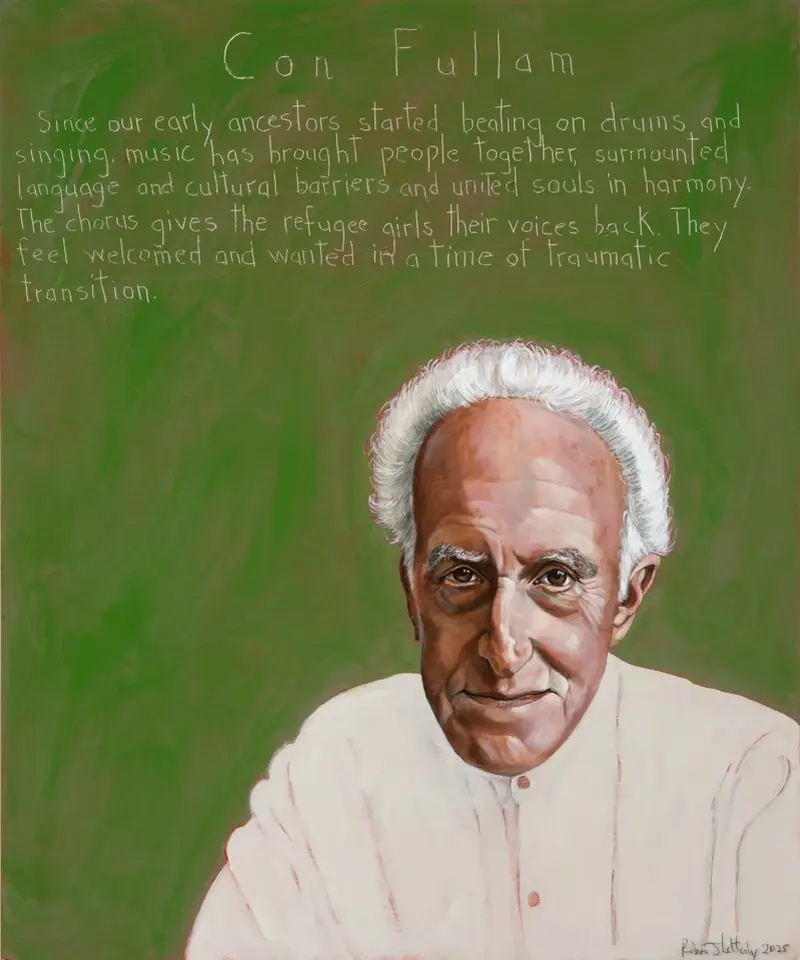
Perhaps it started with his father’s ukulele. Con Fullam’s father, a history professor at Colby College, passed away at age forty-eight when Fullam was five and he inherited the ukulele. “I began to play it and it gave me a sense of agency,” he recalls. The family all had their instruments, and his mother was both an English teacher and a choir director. Fullam began to write music and started his first band at fourteen. Now, many decades later, these humble musical beginnings have given rise to the Pihcintu Multicultural Chorus, welcoming immigrant children from around the globe, embracing and inspiring them as they restart their young lives.
Paul Conway Fullam grew up in Sidney, Maine, a small town on the Kennebec River. He attended New Division, an experimental college which closed abruptly when he was a student there. “When college ended, I just picked up my guitar and started playing for a living.” He ended up in New York City where he peddled his songs to publishers by day and performed in the clubs by night, resulting in publishing deals with Warner/Chappell, MCA Universal, RCA, and Chrysalis.
After spending time in Florida, Nashville, and New York City, Fullam signed a deal with Epic Records and bought a farm in Maine. When the record deal went awry, he began reinventing himself.
In 1984, Fullam composed and wrote the lyrics of “The Maine Christmas Song,” based on his memories of growing up in rural Maine. The song has sold over a hundred thousand copies and spawned an illustrated children’s book. Fullam created and produced A Very Wompkee Christmas (2003) and The Hidden Treasure of Wompkee Wood (2009), both of which aired on PBS, Starz, and Amazon Prime and were distributed in over fifty countries. From 2005-2008, he was an executive producer and writer for the multi-award-winning animated series Ribert and Robert’s Wonderworld on PBS.
Concerned about the plight of immigrants and refugees coming to Maine, he decided to do something about it. “I formed the chorus [in 2005] to give girls their voices back,” Fullam explained.“I know what it’s like to lose something that’s very dear to you and have no control over it,” he said, recalling his father’s death.
He named the chorus the Pihcintu Multicultural Chorus. In Wabanaki language, Pihcintu means “When they sing, their voices carry far.”
In college he had worked at Camp Waban, in North Berwick, Maine, a camp for children with disabilities. “It was very powerful for me. That formed some sense of what I might be able to do. It took a long time for it to gestate but here we are,” he said.
“Here” is a busy place for a retired man in his seventies. He doesn’t just lead the chorus; he is also the band leader, van driver, accompanist, and cheerleader for the young women as they sometimes struggle with limited means of communication and competing job schedules, as many begin working as soon as they turn sixteen. Planning and coordinating can take far longer than rehearsing and performing.
“I’ve probably had four-hundred-plus girls go through this chorus,” he said. “Certainly, there is trauma but these girls are immensely resilient.” These lyrics from Pihcintu’s “A Song for the Homeless” demonstrate how the chorus gives voice to the girls’ story:
And I am just a child, but my childhood’s been broken
I am just a child much older than my years
I am just a child but my soul is drowning
In sorrow, sadness, terror and tears.
And I am not alone, there are millions just like me
No, I am not alone crying who will let us be . . .
Children riding bikes, climbing trees, falling down, laughing, skinning
our knees, just being children, living
And loving children. / Please, let us be children.
The singers have come from dozens of countries. Pihcintu has performed for Bono at a meeting of the General Assembly of the United Nations, with YoYo Ma in Bar Harbor, and at the Kennedy Center for Performing Arts in Washington, D.C. When asked what is their greatest accomplishment, Fullam proudly states that 100 percent of girls who have been in the choir have graduated from high school and that most go on to post-secondary education.
Fullam was also a founder of Greenlight Maine Productions and was the show runner for the first five seasons of Greenlight Maine, a PBS series that has garnered four Emmy nominations. The show is an economic engine and job creator for the state of Maine. This led, in 2020, to Fullam creating Elevating Voices, a documentary series designed to spotlight the importance of immigrants and refugees to the state of Maine’s economic and cultural vitality.
Pihcintu gives Fullam yet another platform to talk about how the girls’ families are helping to build Maine’s economy; many of their parents work in healthcare, agriculture, and manufacturing—areas which have severe labor shortages. Some have started businesses of their own, revitalizing downtowns that have experienced job loss and population decline. “You can hate from afar but when they’re your neighbors and you see that they’re hardworking folks contributing to the community, they’re much harder to hate,” Fullam said.
Fullam was one of Maine Magazine’s Mainers of the Year in 2021, a 2024 selectee of Marquis Who’s Who in America, and the recipient of the Maine Education Association’s Ashley Bryan Award for Arts and Humanities, as well as the Maine Education Association’s Human and Civil Rights Award.
– authored by Sarah Pebworth (2025)