
Sherrilyn Ifill
Sherrilyn Ifill
Civil Rights Advocate; Attorney; Constitutional Scholar; b. 1962
“I believe that we must begin with hard truths about the power of racism and its grip on this country. It lives in our national DNA. And until we are ready to take aggressive measures to contain it, we will never be able to secure and protect democracy in America from its devastating effects.”
Biography
A person does not become a member of the TIME100, an annual listing of the most influential people in the world, by playing it safe. Instead TIME magazine includes those who “broke the rules, broke the record, broke the silence, broke the boundaries. They are seekers, with a fearless willingness to be surprised by what they find.” These qualities perfectly describe civil rights activist, professor, and visionary leader Sherrilyn Ifill. Named to the list in 2021, Ifill’s extraordinary efforts in the fight against systemic racial injustice, along with her persistent messaging to voters and policymakers on what it takes to preserve American democracy, placed her alongside Alexei Navalny, Kamala Harris, Billie Eilish, and ninety-six others whose work is changing the world.
Ifill started her career following in the path of American icons Thurgood Marshall and Constance Baker Motley by litigating voting rights cases on behalf of minority citizens whose civil rights had been violated. In 1993, after several years as an attorney with the American Civil Liberties Union (ACLU) and NAACP Legal Defense Fund (LDF), Ifill joined the faculty of the University of Maryland Law School. Ten years later she returned to the LDF to become the organization’s seventh president and director-counsel. During her tenure the organization grew significantly in staffing and endowment and bolstered its position as a crucial player in the fight for social justice and equal opportunity. Her journey in and out of the courtroom, classroom, and executive offices of non-profit organizations and universities has been fueled by a keen intellect, no-nonsense communication style, and bravery that speaks to and inspires people from all walks of life.
Her frank words resonated with those devastated by the 2020 murder of George Floyd at the hands of people responsible for upholding the law. “There are moments in this country when there are photographs that are snapshots of the soul of this country,” Ifill referred to the nine-minute video of Derek Chauvin holding his knee to Floyd’s neck, slowly strangling him. “When we see this picture of the nonchalance with which America will put its knee on the neck of black people and make itself deaf to our suffering, deaf to our cries, deaf to our desperation, that’s the snapshot. That’s America. It’s not about a bad apple. It’s about a system.” Ifill’s words inspired and encouraged people to join the fight for equality and justice.
In 2023, as keynote speaker at Tulane University’s Black Law Alumni Reunion, Ifill spoke with characteristic candor about the threats to American democracy. She cited voter suppression, judicial ethics scandals, the normalization of white supremacy, and the marginalization of Blacks, women, and immigrants as key factors in the weakening of our government and our culture. Two years later, as judges’ rulings go unheeded and President Trump issues executive orders to dismantle systems that support people of color and the most vulnerable members of society, her warnings feel prescient.
“Autocracy is contagious,” Ifill warns as she watches elected officials and politicians venture into behaviors that break the barriers of social and legal norms. The banning of books, refusal to obey court orders, destruction of programs aimed at equity, and flaunting of immoral words and behaviors have become weapons in a war over power. “They’re not getting the pushback. . . . there’s very little to stop them . . . because we didn’t create the kinds of rules and laws and regulations that you need in a democratic infrastructure for just such a moment as this. You can’t wait until the autocrat comes to power.”
The will of the Supreme Court to check such power was tested in Trump v. Anderson, the 2024 case that appealed a Colorado Supreme Court ruling giving the state authority to disqualify Trump from its primary ballot. The Colorado court based its decision on Section 3 of the Constitution’s 14th Amendment which reads,
“No person shall be a Senator or Representative in Congress, or elector of President and Vice-President, or hold any office, civil or military, under the United States, or under any State, who, having previously taken an oath . . . shall have engaged in insurrection or rebellion against the same.”
Ifill submitted an Amicus brief arguing in favor of the Colorado ruling, stating that Section 3 “was enacted for such a time as this, and for such a figure as President Trump . . . Trump’s attempt to overturn the election began well before January 6th . . . Trump stoked his followers for over a month with a false narrative discrediting the votes cast by voters in jurisdictions with high concentrations of Black voters.” Ifill concluded, “Allowing a constitutionally disqualified candidate to appear on the ballot despite a finding of participation in insurrection would powerfully undermine the fact and perception of the rule of law and fundamental fairness.”
The Supreme Court dodged the difficult question of insurrection and instead ruled on procedure, overturning the Colorado court’s decision on the grounds that only Congress, not the states, had the authority to enforce Section 3 of the 14th Amendment. “It’s consistent with this Court’s refusal to be moved from the narrative that we are somehow impervious to the politics of what’s happening around us . . . [W]hat they do is they just carry on business as usual, and I suspect, to their mind, they think it is carrying forward a narrative of impartiality . . . The majority of this Court is not prepared to meet the moment.” Ifill sees the Supreme Court’s unwillingness to hold politicians accountable as a Constitutional crisis that places responsibility for sustaining democracy in the hands of the people.
“It is going to take the work of all of us,” Ifill reminds us. “All of us deciding to do the hard work. And that means that voting every four years is not enough.” She forcefully challenges citizens to participate in local elections and cast ballots for town councilors, school board members, and state representatives. She calls on us to volunteer as poll workers and to reach out to our representatives to share our opinions. “Or better yet,” she says, “run yourself. It is not enough to vote and think we’re done.”
As founder and director of Howard University School of Law’s 14th Amendment Center for Law and Democracy, Ifill continues her efforts defending democracy using our nation’s founding documents—the Declaration of Independence and what she calls the second Constitution. The second Constitution, created following the Civil War, added the 13th, 14th, and 15th amendments and removed compromises made in the first Constitution to allow the continuation of slavery and count enslaved people as three-fifths of a person. Ifill credits the 14th Amendment for shaping America today, explaining that “what the 14th Amendment does is it reaches back over the first Constitution all the way back to the Declaration of Independence” and embeds in the Constitution the truth that “all men are created equal.”
Ifill believes we can overcome current threats to our system. “I remain committed to imagining and creating a new America. A true multi-racial democracy centered around equality and justice. I believe it lies just over the hill. I do not need to see it in my lifetime to know that it can happen. That it will happen.” She again calls on the people, “But I—we—do need to do the work to lay its foundation.”
-authored by Julie Gronlund
Related Portraits


Programs
Americans Who Tell the Truth (AWTT) offers a variety of ways to engage with its portraits and portrait subjects. Host an exhibit, use our free lesson plans and educational programs, or engage with a member of the AWTT team or portrait subjects.

Education
AWTT has educational materials and lesson plans that ask students to grapple with truth, justice, and freedom.
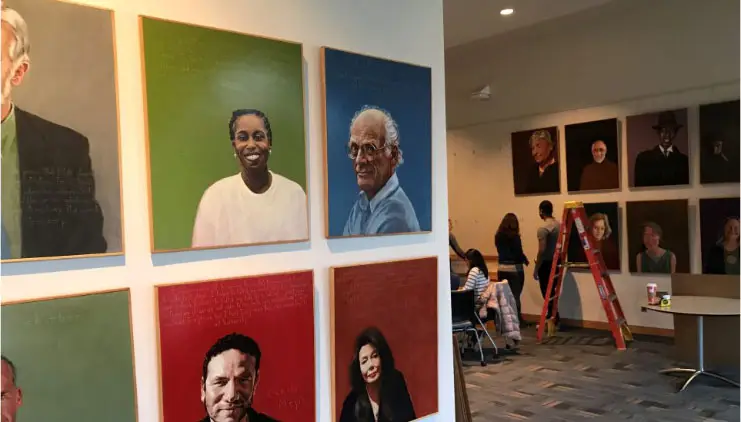
Exhibits & Community Engagement
AWTT encourages community engagement programs and exhibits accompanied by public events that stimulate dialogue around citizenship, education, and activism.