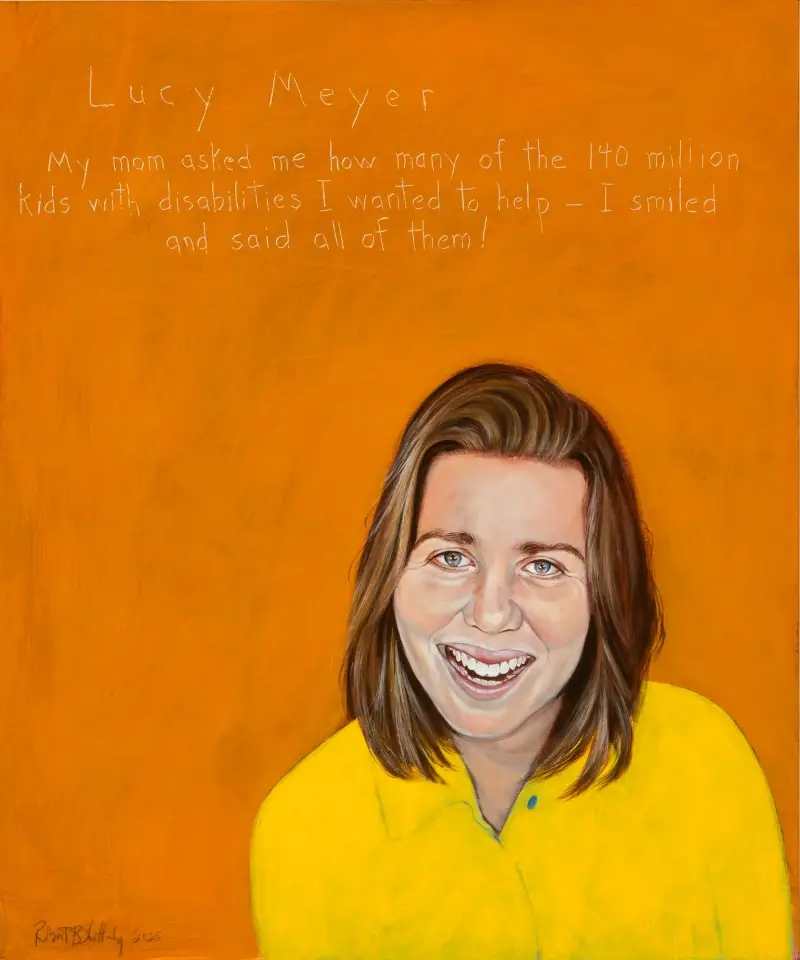
Lucy Meyer was born with cerebral palsy as a result of oxygen deprivation at birth. Doctors originally thought she might never be able to sit up or swallow.
Lucy’s father Chuck remembers the difficult time just after Lucy was born: One of Lucy’s doctors, after checking various readings and test results, “pulled a small brass bell out of his black medical bag. He rang the bell to Lucy’s left side and then to her right side. It was clear that she heard the bell! Maybe less clear, but I was ready to grab anything positive, was the movement of Lucy’s lips, which looked like it might be a smile. Maybe not entirely rational, but at that moment I believed that there was hope—that Lucy . . . was going to defy the prognosis that she was given. Boy, did she!”
Today, Lucy is an international advocate and spokesperson for young people with disabilities. She recalls, “When I was in fourth grade, my mom got involved in a children’s international organization called UNICEF. She shared with me the important work that UNICEF does to help kids all over the world. I watched the videos and it made me cry—especially when I saw how some other countries treat their kids with disabilities.” She didn’t just carry a UNICEF box trick or treating at Halloween—she dressed up as one. The UNICEF Southern California Regional Board noticed her passion and desire to help.
UNICEF asked Lucy’s parents to speak about children with disabilities to bring awareness to the tragic circumstances that many of these children face in developing countries. Lucy remembers, “I asked if I could speak instead. It was my first speech and I loved it. We raised so much money that UNICEF asked if I wanted to create my own website and become their advocate. From there, things just snow balled!”
Lucy lives with both physical and intellectual disabilities, but she has never let these obstacles stop her. In spite of her own challenges, she has devoted herself to promoting acceptance, inclusion, and assistance for all people—especially those with disabilities.
She has worked with Special Olympics, a sports movement to end discrimination against people with intellectual disabilities. Before Special Olympics, Lucy wasn’t given the opportunity to compete. “When I was around 10 years old, many of my friends who didn’t have disabilities got involved in team sports. I wanted to play too but I was told no because of my disability. The closest I came to playing team sports with my friends was being the referee. Most of the time, I just sat on the bench and cheered them on,” Lucy remembers. “Then someone told my mom about Special Olympics. I joined the Special Olympics swim team and loved it! I learned to train hard and focus on healthy eating because I was an athlete just like my other friends without disabilities. It was the first time that I felt the joy of competing and winning.”
Lucy, from Los Angeles, California, went on to become a five-time Special Olympics gold medal winner in swimming.
Lucy knows Special Olympics programming is effective in decreasing stigmatization and providing an atmosphere of acceptance and inclusion; she knows from her own experience. Special Olympics Regional President David S. Evangelista has worked with Lucy for years. “Her voice continues to engage new audiences through her leadership and her vision of a world fully inclusive. She remains one of my most powerful mentors and guides as we look to make inclusion a reality for all across the world,” he said.
Lucy has raised millions of dollars to help young people. Her advocacy work for the acceptance and inclusion of young people with disabilities has taken her to the United Nations and the U.S. Congress, as well as to meetings with ministers and officials throughout the world. She has visited Jamaica, Azerbaijan, and Kosovo, to name just a few countries. Audiences of one or one hundred are drawn in by her relentless optimism and enthusiasm.
When Covid-19 shutdowns curbed her travel, she pivoted to speaking to students online. Since she began in elementary school, she has addressed more than 60,000 students, including her high school graduation class. She helped raise more than $100,000 for Special Olympics and UNICEF USA at her graduation reception.
“My favorite speeches are the ones I give to kids at schools,” says Lucy. “Often kids don’t know what it’s like to have disabilities. They have great questions. They really get it that while everyone has differences, we all like many of the same things. This is the message we want to spread around the world.”
Lucy asks each student to make a personal commitment to befriend classmates they see being left out, whether because of a disability or any other reason. She believes that everyone has an obligation to give back and encourages children to do more. She’s not afraid to set kids straight by telling them, “You’re not disabled but a person with disabilities.”
A life-long friend, Angie Estrada, attributes Lucy’s effectiveness to her emotional intelligence and ability to understand others. “Lucy has been fighting since she was born, fighting for life at first breath to fighting through her physical limitations throughout her life,” Angie said. “She’s known struggle and has never let that get her down. She’s able to recognize on a soul level that struggle for others. Her simple, ‘Are you okay, bud?’ makes all the difference because it comes from a place of true love with Lucy.”
Now living in Vermont, Lucy is looking forward to horseback riding, skiing, and traveling internationally as she continues advocating for children with disabilities.