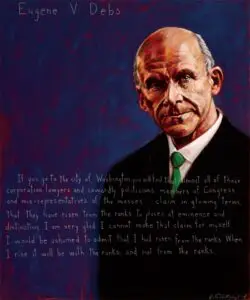

As Labor Day 2025 approaches, we are mindful of all of the labor advocates who have gone before us, improving the lives of working people. If you go to the AWTT portrait gallery and filter for “worker’s rights,” you’ll find forty such outstanding figures who have fought and sacrificed over the decades, to bring workers safer working conditions, reasonable hours, living wages, paid vacations, and benefits. Some early nineteenth-century models of courage and vision are Mother Jones, Eugene V. Debs, Ida Tarbell, and Emma Goldman. Standing on their shoulders, from our century, are Ai-jen Poo and David Zirin. (Watch short video interviews with these two outstanding worker advocates here (Poo) and here (Zirin).)
But perhaps the most influential advocate for workers’ rights over the course of our national history is the proper-and-pragmatic, God-loving, self-effacing public servant of the twentieth century, Frances Perkins. The first woman to hold a U.S. presidential cabinet post, Perkins served as Secretary of Labor during the entire span of the Roosevelt administration (1933-1945). Facing many personal challenges during that time—persistent financial issues, her husband’s and daughter’s mental illnesses, and discrimination from other cabinet members, to name a few—she attempted to resign several times, but FDR always refused to accept her resignations. She was a key adviser and confidant; he needed her insight and level-headed wisdom.
Although Perkins was drawn to public service from a young age, her life was transformed in 1911, when she witnessed the fire at the Triangle Shirtwaist Company, where 146 young women died in the worst industrial disaster in New York City history. Perkins watched as many workers, trapped behind locked doors, jumped to their deaths from the ten-story Asch Building. Horrified by what she saw, Perkins worked on the New York State Factory Commission—established in response to the fire—to improve job safety. She testified before the state legislature and organized lawmaker visits to factories and workers’ homes. Her tactics were successful. Over the next few years, New York passed laws and codes to protect workers, compensate them for injuries incurred while on the job, and limit working hours for women and children.
By the time Franklin Delano Roosevelt was first elected president, in 1932, Perkins’s (somewhat complicated) relationship with him was already well-established, through their legislative work in New York. By this time, she had developed a comprehensive policy agenda and did not want to serve if Roosevelt was not committed to it. “I don’t want to say yes to you unless you know what I’d like to do and are willing to have me go ahead and try.” Her agenda included a federal minimum wage, maximum work hours, unemployment benefits, social security, and universal healthcare. Roosevelt was certain she was the person he wanted, promising her that he would support her ideas. So, with some trepidation, she agreed.
During the next tweleve years, Perkins accomplished almost all of her goals—with the exception of universal health care and her lesser-known agenda of welcoming more immigrants who were fleeing Nazi terror. Perhaps her most significant and lasting accomplishment was passage of the Social Security Act. Despite his promise, Roosevelt pushed back on this initiative in the beginning, believing that it was too big and too controversial. But Perkins persisted, thoroughly researching existing systems throughout the western world and trying out different ideas until one stuck. The Frances Perkins Center, in Newcastle, Maine, is hosting a celebration around the 90th anniversary of the Act on September 7, 2025.
A woman of deep faith, Perkins was committed to God, to family, and to community, in that order. “I came to Washington to work for God, FDR, and the millions of forgotten, plain, common working men.” Throughout her twelve years as Secretary of Labor, she nurtured her faith by spending at least one day a month at the All Saints’ Sisters of the Poor convent in Catonsville, Maryland. And that deep faith grounded her with the stamina and courage to accomplish what many thought was impossible.