Art as the New Deal: How the vision of Frances Perkins and the WPA extended relief to the human spirit, supporting the creative arts.
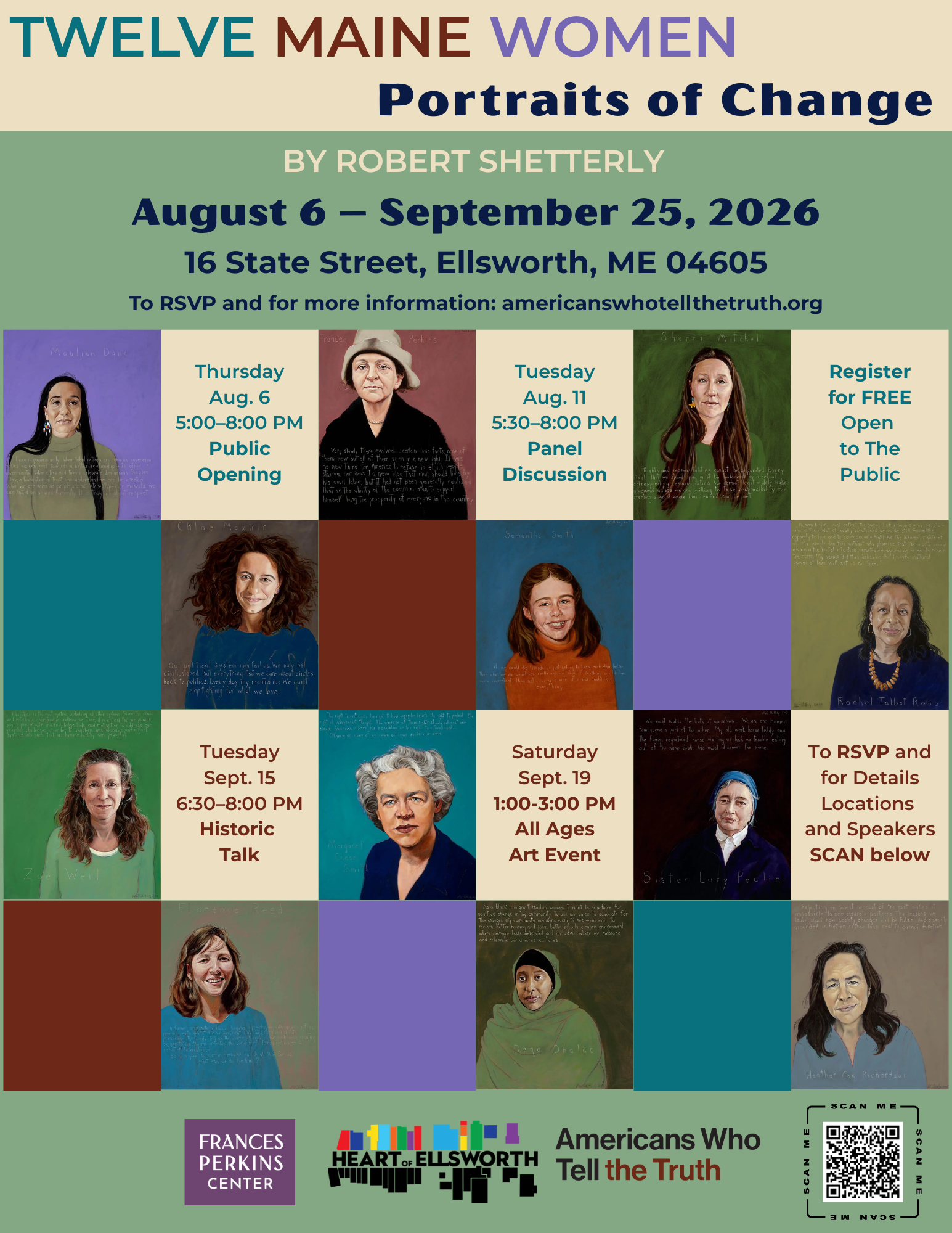
A featured event of this ongoing exhibit, “Twelve Maine Women: Portraits of Change,” will take place at 6:30 p.m., Tuesday, September 15, 2026, at the Ellsworth Public Library, 20 State Street.
Reserve your space for this free event here
In the depths of the Great Depression, the New Deal did more than rebuild America’s infrastructure—it rescued its soul. Under the visionary leadership of Labor Secretary Frances Perkins and the architects of the Works Progress Administration (WPA), the federal government made an unprecedented investment in the creative economy. By treating artists, writers, musicians, and actors as vital workers worthy of relief, Federal Project Number One proved that art is not a luxury, but a public good essential to the human spirit.
This panel explores the legacy of Frances Perkins, the first female cabinet member, and the WPA arts initiatives and their profound impact on American culture.
Moderator: Dillon Murray
Panelists:
Dillon Murray
Legislative Liaison, Maine Department of Labor
Dillon Murray serves as the Legislative Liaison for the Maine Department of Labor, where he works with the Maine Legislature, employers, workers, and community partners on labor policy and workforce issues. In this role, he helps advance initiatives that strengthen Maine’s workforce and promote safe, fair, and equitable workplaces.
A graduate of the University of Maine, Murray is deeply committed to public service and civic engagement. He has been an advocate for equity and inclusion, speaking publicly about his experiences growing up in Maine and the importance of creating communities where everyone has the opportunity to thrive.
Kate Webber
Kate joined the Frances Perkins Center as Curator in 2026. She has been working with Maine’s cultural organizations for fifteen years, from cities to islands. She holds an M.A. in Museum Studies from the Cooperstown Graduate Program, where she focused on programming and public history. Kate has worked at the Maine State Museum, Museum L-A, and the Maine Humanities Council. She spent two years on Swan’s Island as a Historical Preservation Fellow with the Island Institute. Kate is a graduate of Bates College, where she studied Anthropology with a concentration in Environment, Place, and History. Kate currently serves on the board of the Maine Association of Archives and Museums.
Peter Kellman is a lifelong labor organizer, educator, author, and social justice activist whose work has helped shape the modern labor movement in Maine and beyond. For more than six decades, he has dedicated his life to advancing workers’ rights, economic justice, and democratic participation through grassroots organizing, education, and public advocacy.
Kellman’s activism began during the Civil Rights Movement of the 1960s, when he participated in the historic Selma-to-Montgomery voting rights march and worked with the Student Nonviolent Coordinating Committee (SNCC) in Alabama. He also became active in the anti-war movement before turning his focus to labor organizing, where he would leave a lasting mark on the American labor movement.
Throughout his career, Kellman has organized workers across New England, served as President of the Southern Maine Labor Council, represented the Council on the Maine AFL-CIO Executive Board, and helped develop innovative organizing strategies that emphasized worker leadership and solidarity. He is perhaps best known for his role in the landmark 1987–1988 International Paper strike in Jay, Maine, one of the defining labor struggles of the late twentieth century, where his organizing helped transform a local strike into a nationally recognized movement for workers’ rights.
A respected labor historian and author, Kellman has written extensively on union organizing and labor history, including Divided We Fall: The Story of the Paperworkers’ Union and the Future of Labor, Building Unions: Past, Present and Future, and Pain on Their Faces. His work has inspired generations of labor leaders, organizers, and advocates committed to building a more just and democratic society.