
People who shut their eyes to reality simply invite their own destruction. – James Baldwin
Years ago, in the 1970s, when I was first living in Maine, industrial logging, clear cutting, and aerial insecticide spraying by paper companies were contentious issues. The nascent environmental movement raised the alarm about the health ramifications of these practices for humans, as well as everything connected with the ecology of the forest—plants, animals, birds, insects, water. For many people, though, the first awareness of clearcuts was their dispiriting ugliness—that snarl of utter decimation suggesting the brutality of war: blitzkrieg. Clearcuts mimicked Hiroshima and Dresden. They exemplified ruthless, efficient exploitation in the service of maximum profit. Meanwhile, in Vietnam, the United States was defoliating the lush forests with the persistent poison Agent Orange—not to harvest the trees but to harvest the soldiers hiding under them. In Maine a clearcut harvest exemplified a willful ignorance of the interdependence of humans and nature.
Paper companies were sensitive to the charge of violently laying waste to Maine’s identity as the Pine Tree State with its mythic northern forest. They tried as best they could to make the devastation invisible. Along the roads traversing the north woods, loggers left a “beauty strip,” a fifty-foot deep hedge of trees. That concession attempted to shield sensitive motorists from witnessing, as they whizzed by, the ruination of the woods beyond. If a driver slowed down, the clearcuts were visible through breaks in the trees. The paper companies were like little kids who, holding their splayed fingers over their eyes, think they are invisible. And most passersby played the game, shut their eyes to reality. Who wants to admit, while enjoying Vacationland, to be surrounded as far as the eye can see by a desolation of stumps, roots, and slash strewn about in the muddy ruts of the skidders that dragged the forest away? There’s a synchronization between people who would rather not know with the interests of those who would rather they not know.
As critical as forest management practice is, it’s not that woods I want to explore—except as a metaphor. What concerns me is the kind of beauty strip pulled in front of a political or moral atrocity to keep us from seeing, or that gives us permission not to see what’s really there—and take responsibility for it—as we go on our merry way. The world’s current atrocities are partially obscured by thin scrims thrown up in front of them. These beauty strips are woven with financial interests, propaganda, prejudice, power, and denial, blinding us to the overwhelming death and misery we are complicit in. Palestinians in Gaza and the West Bank are the objects of genocide— industrial clearcut, you might say. Iranians are, too. And Lebanese. U.S. weapons makers, our merchants of death, are making billions from slaughter. Our major media, whose responsibility it is to shine a light on the truth, equivocate, enabling the continuation of genocide. In the name of “fair and balanced,” they give equal time to the justifications for demented barbarity. “Fair and balanced” is the beauty strip that relieves the sighted of sight and redirects us to the refuge of moral indecisiveness.
On the environmental front, also behind the scrim of balanced reporting, mass extinction of species and climate change accelerate. We are encouraged to celebrate beauty in a diminished world. Ironically, then, the diminished world is its own beauty strip.

Dr. Martin Luther King, Jr., was famous for saying, “The moral arc of the universe is long but it bends toward justice.” This statement is a profound, cosmic wish fulfillment of an oppressed people. It’s the belief that goodness is imprinted deep in the genome of the universe. For people struggling for justice, that moral arc is the North Star fixed in the celestial night. It’s Hope itself. Looking at the world today, that statement about the moral arc seems sentimental at best. What we witness behind the wish-fulfillment beauty strip are people of power—leaders, we call them—relishing cruelty, destruction, dishonesty, corruption, atrocity. These people delight in proudly, righteously bending the arc toward injustice. And they, like circus contortionists, want to bend it so far that you’d think it can never bend back. Why? What grudge do the super-powerful and super-wealthy have against the world—the less powerful, the less rich, the non-white? They use power to teach futility, bend the arc into a cul-de-sac of despair. They seem to prefer a world where hope for the unprivileged is a black hole from which no light escapes.
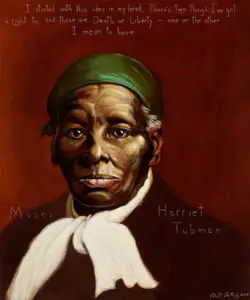
The point here is that people struggling for justice cannot allow themselves the soporific hesitation of fair and balanced, cannot allow themselves a doubt that maybe the injustice isn’t really so bad. Harriet Tubman carried a pistol—not so much to protect fleeing slaves from stalking slave hunters and their dogs but to warn the fleeing enslaved that the beauty strip of doubt and fear would not be countenanced.The arc of freedom is a one way transit. The weak of heart slipped off the arc.
The wrongs in the world today are enormous, and most of us feel that our agency to affect them is tiny. It seems that we are obliged to carry the weight of its darkness, while those who create darkness are oblivious to their crimes. As a result we suffer from moral injury, a term used to describe people, often soldiers, who have committed or witnessed acts of extreme violence, acts that conscience abhors. As citizens, internalizing our violent, racist history causes moral injury. To ignore it, though, erases the truth of our identity. Choosing to remain “unwoke” may insulate us—as a beauty strip does—from our disturbing past but also renders us incapable of fixing the legacy of problems the past created. For an empathetic person, merely being conscious of our current atrocities causes moral injury. Moral injury is a kind of original sin—not one all humans are born with but one engendered by avoidance and complicity.
As I was writing this, I was thinking of the final lines of Mathew Arnold’s great 19th century poem “Dover Beach”:
Ah, love, let us be true
To one another! for the world, which seems
To lie before us like a land of dreams,
So various, so beautiful, so new
Hath really neither joy, nor love, nor light,
Nor certitude, nor peace, nor help for pain;
And we are here as on a darkling plain
Swept with confused alarms of struggle and flight,
Where ignorant armies clash by night.
The philosophical sentiment of these lines denies a moral arc bending across time toward justice. Instead, hope for compassion and kindness is reduced to a woebegone appeal between lovers. Mathew Arnold speaks with clear-eyed pessimism as a witness from the lightless “darkling plain.” His pessimism becomes a kind of dismal invitation to remove the beauty strips. The ugly clearcut is the truth; the violent rapacity of the powerful is the truth. The worst that human beings do is the truth. That truth is the ruination of us all . . . except the meager hedge of decency between individuals.
One cannot deny the omnipresent pathology of the ignorant armies. Yet, I prefer the image of Harriet Tubman, chasing the North Star, wading through a swamp at night, the star reflected as a pinprick of light on the barrel of her pistol. Courage is its own light, creates its own arc.