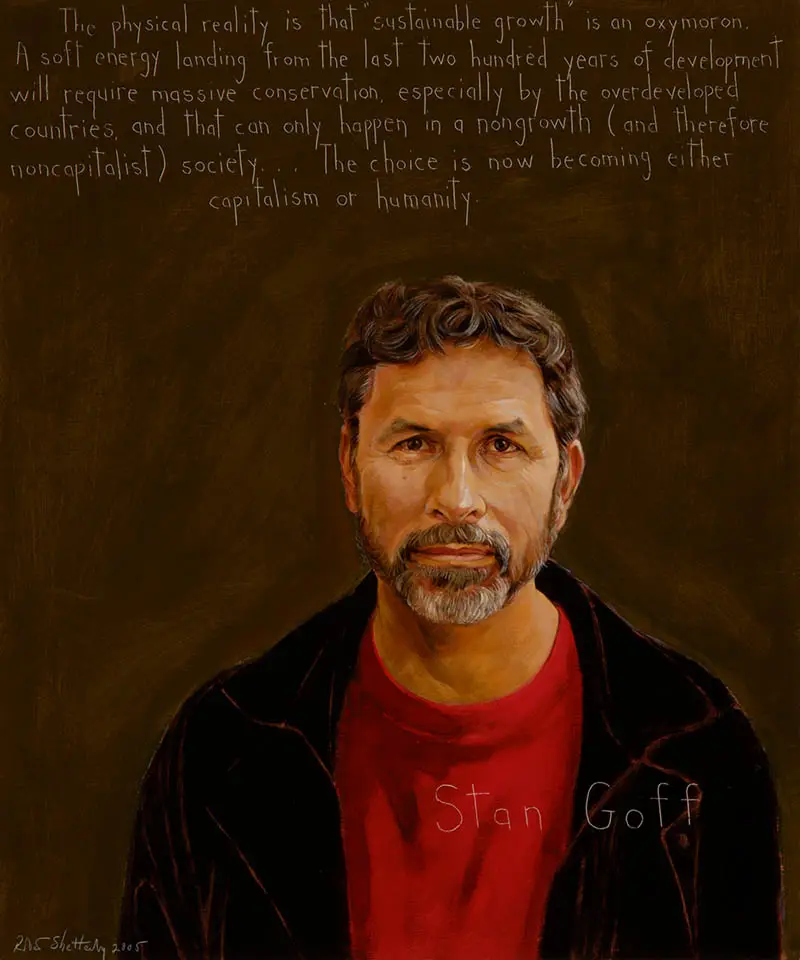
Stan Goff
Stan Goff
Author, Veteran, Anti-war Activist, Christian, Feminist : b. 1951
“The physical reality is that ‘sustainable growth’ is an oxymoron. A soft energy landing from the last two hundred years of development will require massive conservation, especially by the overdeveloped countries, and that can only happen in a nongrowth (and therefore noncapitalist) society. The choice is now becoming either capitalism or humanity.”
Biography
Stan Goff grew up in a staunchly conservative, anti-communist family. In 1970, he joined the Army. Goff retired in 1996 as a Special Forces Master Sergeant. During his tenure, he was sent to Vietnam, Haiti, Panama, Colombia, and Somalia, participating in several different military attachments. Goff would later write that his time spent in Latin America shifted his politics to the left. His experiences, particularly in Haiti, are recounted in his 2000 book, Hideous Dream: A Soldier’s Memoir of the US Invasion of Haiti.
In between stints in the military, Goff studied literature and philosophy at Garland Community College, Henderson State College, and the University of Arkansas at Monticello. Soon after retirement, Goff began a career in activism, studying Marxism and briefly joining the Communist Party USA.
After the September 11, 2001 attacks in New York City, Goff became active as a speaker against an invasion of Iraq. His status as a veteran gave him credence and popularity with anti-war activists. In 2003, Goff wrote “Bring ‘Em On?” for the online journal Counterpunch. It was a response to the taunting phrase “Bring ’em on!” uttered by President Bush regarding Iraqi guerrillas. In the article, Goff compared the Iraq war to his experience in Vietnam. He wrote of being told by a fellow veteran that “All Vietnamese were the enemy. . . this was a race war. Within one month, it was apparent that everything he told me was true, and that every reason that was given to the American Public for the war was not true.” He ended by stating that President Bush’s “legitimacy has been eroded as even the mainstream press has discovered that the pretext for the war was a lie. It may have been control over the oil, after all.”
The popularity of this article led to the formation, with other veterans and activists, of the organization Bring Them Home Now.
His 2004 book, Full Spectrum Disorder: The Military in the New American Century, critiqued U.S. foreign policy. According to the publisher, Goff “depicts the new ‘American Empire’ as over-reliant on technology, ignorant of the lessons of history, and backward in the stereotyping of other countries.”
Goff began studying and writing about feminism, particularly how it relates to war. His later books focused on this theme. Sex and War (2006) challenged the cultural assumption that men are born to fight. He dug further into the themes of war, feminism and Christianity in Borderline – Reflections on War, Sex, and Church (2015). Mammon’s Ecology – Metaphysic of the Empty Signa (2015) explores “the ‘deep ecology’ of (post)modern power and injustice.” In Tough Gynes: Violent Women in Film as Honorary Men (2019), Goff returned to the themes of feminism, masculinity, and violence, analyzing films that feature violent female protagonists. He described it as a “feminist-friendly examination of films with violent female characters. . . . “tak[ing] a fresh look at certain shared cultural certainties that continually reproduce the idea of redemptive violence, now with women as tokens, decoys, and sexually objectified icons.”
Stan Goff has been an active voice online, as a contributor to The Huffington Post, CounterPunch, Common Dreams, and Truthdig, among others, while actively contributing to many justice projects, including SourceWatch, CBE International, and Charter for Compassion.
Programs
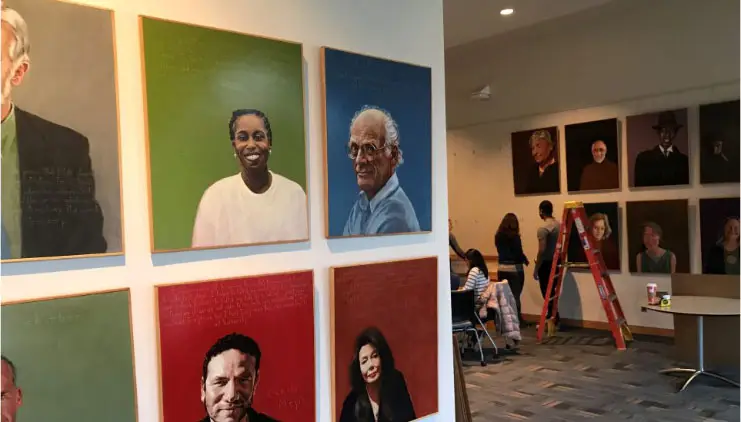
Americans Who Tell the Truth (AWTT) offers a variety of ways to engage with its portraits and portrait subjects. Host an exhibit, use our free lesson plans and educational programs, or engage with a member of the AWTT team or portrait subjects.

Education
AWTT has educational materials and lesson plans that ask students to grapple with truth, justice, and freedom.
Exhibits & Community Engagement
AWTT encourages community engagement programs and exhibits accompanied by public events that stimulate dialogue around citizenship, education, and activism.